9 April 2026 • Work safe & secure
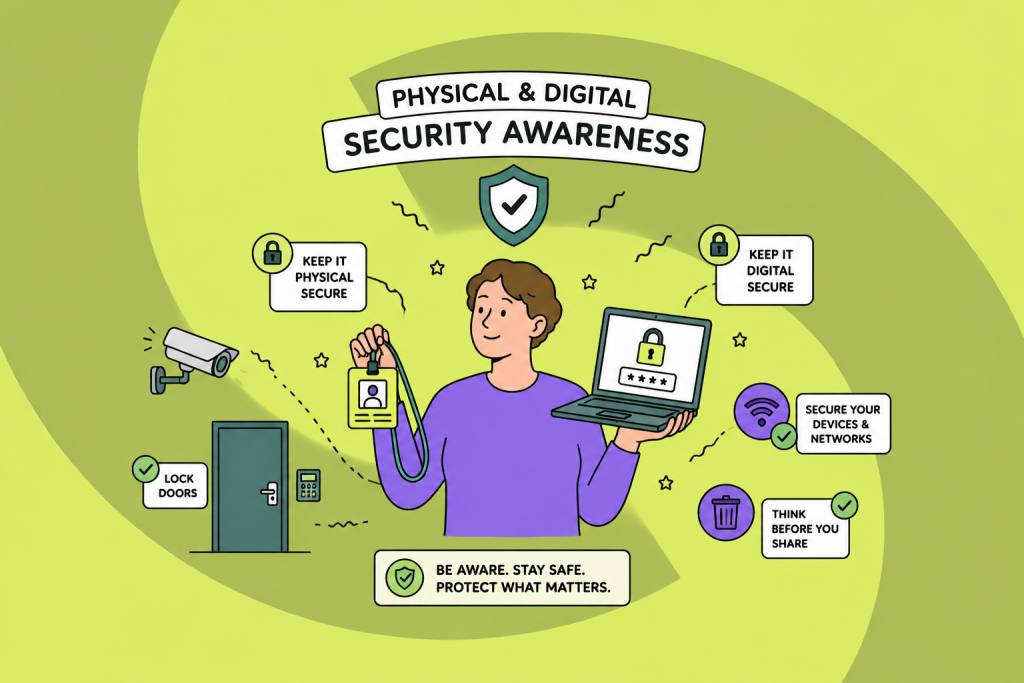
Security awareness is the ability of employees to recognise threats, assess them, and respond correctly. Most organisations focus on digital risks, but physical threats are just as real. An employee who holds open a secure door for a stranger is just as much a liability as one who clicks a phishing email. True security awareness covers both.
Why physical threats are just as dangerous as digital ones
Physical security threats are easy to overlook because they do not trigger a firewall alert or antivirus warning. They happen in hallways, reception areas, and car parks. A visitor who gains access to a server room, a printed report left on a desk, or a phone call from someone claiming to be IT support: none of these show up in a system log, but all of them can lead to a serious breach.
Effective security awareness addresses both layers: physical security and digital security. Together they form the behavioural foundation beneath every security policy.
Physical and digital threats compared
| Type of threat | Physical example | Digital example |
|---|---|---|
| Unauthorised access | Tailgating through a secure door | Logging in with stolen credentials |
| Social engineering | Posing as a technician or delivery person | Phishing email from a fake manager |
| Information leak | Leaving confidential documents unattended | Sending sensitive files via personal email |
| Device risk | Leaving a laptop visible in a car | Not locking your screen when stepping away |
| Unintentional exposure | Discussing confidential matters in a public space | Writing a password on a Post-it note |
Want to protect your employees against hacks and phishing?
Discover Guardey's security awareness training. Weekly three-minute challenges turn your team into a cyber defence unit.
Discover security awareness trainingWhy security awareness starts with people, not technology
Firewalls, access passes, and encryption are essential, but they cannot protect against an employee who opens a door for the wrong person or clicks a convincing link. The weakest point in any security setup is human behaviour, and human behaviour can be trained.
Organisations that build security awareness across both physical and digital domains see fewer incidents, faster threat recognition, and a security culture that holds up even when no one is watching.
What does a security awareness course cover?
A good security awareness course does not stop at phishing tests. It trains employees to recognise threats in the real world as well as on screen. Topics typically covered include:
- Recognising phishing attacks and social engineering attempts
- Handling passwords and access credentials safely
- Physical access security and preventing tailgating
- Managing confidential information in the office and on the go
- Reporting incidents: when and how
A one-off course is a start, but not a solution. Knowledge fades quickly when it is not reinforced. Effective security awareness training works continuously: short learning moments, regular repetition, and direct feedback.
Security awareness training with Guardey
Guardey offers a platform for security awareness training that goes beyond an annual e-learning. Employees receive a short challenge every week, covering both physical and digital threats relevant to their organisation. Phishing simulations test real-world responses, and managers get a clear dashboard view of where the risks are.
Security awareness becomes a habit, not a yearly obligation.
Cover both sides of security awareness
Whether the threat is a tailgater at the door or a phishing email, the weak point is the same human decision. Guardey trains employees in weekly three-minute challenges.
Start your free 14-day trial