
20 August 2025 • Cyber security

The moment AI hit the mainstream, it sent security officers into a tailspin. Suddenly, almost everyone was illiterate in a technology that had instantly become critical to information security.
Today, this is no longer just a skills gap. It is a legal duty: the EU AI Act requires every organization that develops or uses AI to provide its employees with AI literacy training. And with national supervisors starting to enforce that duty on 2 August 2026, the topic has moved to the top of the compliance agenda.
In this article, you will learn what AI literacy is, why it is mandatory, and how you can start training your employees to become AI literate.
What is AI literacy and why is it important?
AI literacy is the ability to understand, use, and question artificial intelligence in everyday life. It is knowing what AI can and cannot do, how it makes decisions, and where it fits into the tools we use. It does not mean becoming an AI expert, but becoming aware.
This awareness is much needed. According to Gallup, about half of all employees now use AI in their role, up from roughly one in five in 2023, and the share that uses it daily keeps setting new records. Seemingly overnight, employees started working with a technology that most organizations have not yet been able to train them on.
Research shows how wide that gap still is. In a global study by KPMG and the University of Melbourne among 48,000 people in 47 countries, 66% of employees who use AI said they rely on its output without checking whether it is accurate, and more than half reported making mistakes in their work because of AI. Almost half admitted uploading sensitive company information to public AI tools such as ChatGPT. Meanwhile, only 47% said they had received any form of AI training.
Once employees are trained and do understand AI’s limits and dangers, they are far less likely to make costly mistakes. Think of feeding confidential data into an unsecured AI tool, or blindly following a flawed recommendation from ChatGPT. AI literacy reduces cybersecurity and privacy risks that can seriously harm your organization.
So what does this mean for your employees? In short, they should be able to interpret AI outputs, understand how AI makes decisions, and recognize the potential impact on individuals. But more on that later.
Is AI literacy mandatory?
Yes, it is. Since 2 February 2025, Article 4 of the EU AI Act requires organizations that either develop or use AI (which, let’s be real, is almost any organization) to ensure that their employees attain a “sufficient level of AI literacy”.
In practice, the law treats AI literacy like other compliance topics such as GDPR. You have to take proactive, documented measures, such as training your staff and setting clear internal guidelines, to meet this duty.
And enforcement is about to get real teeth. On 2 August 2026, national market surveillance authorities across the EU officially start supervising and enforcing the AI Act, including the AI literacy obligation. Each member state sets its own penalties. While the EU has postponed some other parts of the AI Act, the AI literacy duty is not one of them. Organizations that cannot show any training effort are the obvious first candidates for corrective measures.
Who needs to be AI literate?
The obligation is not limited to the IT department or a handful of data specialists. It covers everyone who comes into contact with AI in their daily work: the marketer generating copy, the recruiter using an AI screening tool, the manager reading an AI-written summary, and the support agent leaning on a chatbot.
It also applies to organizations of all sizes. There is no exemption for smaller companies, and the duty even extends to contractors and service providers who use AI on your behalf. The required depth does differ per role. An occasional user needs basic awareness, while someone making high-impact decisions based on AI output needs a deeper understanding.
What should AI literacy training involve? (topics and skills)
Now that we have established the importance of AI literacy, what should a training program involve? Here is what you should look for:
- Foundational knowledge: as with any training program, you first start with foundational knowledge. Think of understanding the basic concept of AI, how machine learning works, and newer technologies such as generative AI.
- Business context and use cases: next, it is time to link these foundational concepts to the context of your organization. Training programs should cover how AI can be applied in specific industries or roles. What are common use cases and how do these drive value?
- Ethical and legal guidelines: now that the potential upside has been covered, it is time to discuss potential risks and how to use AI ethically and legally. Employees should learn how to recognize risks such as misinformation, data privacy breaches, and AI hallucinations.
- Safe use in practice: finally, employees should learn the daily routines that keep AI use safe. Verifying output before acting on it, keeping confidential data out of public tools, and recognizing AI-driven threats such as deepfakes and AI-generated phishing.
Guardey’s approach: Integrating AI awareness into security training
At Guardey, we believe that AI awareness should be a part of a broader security awareness training curriculum, which includes topics such as recognizing phishing, safe remote work, privacy, and more. That is why we have built a complete AI awareness track into our training program.
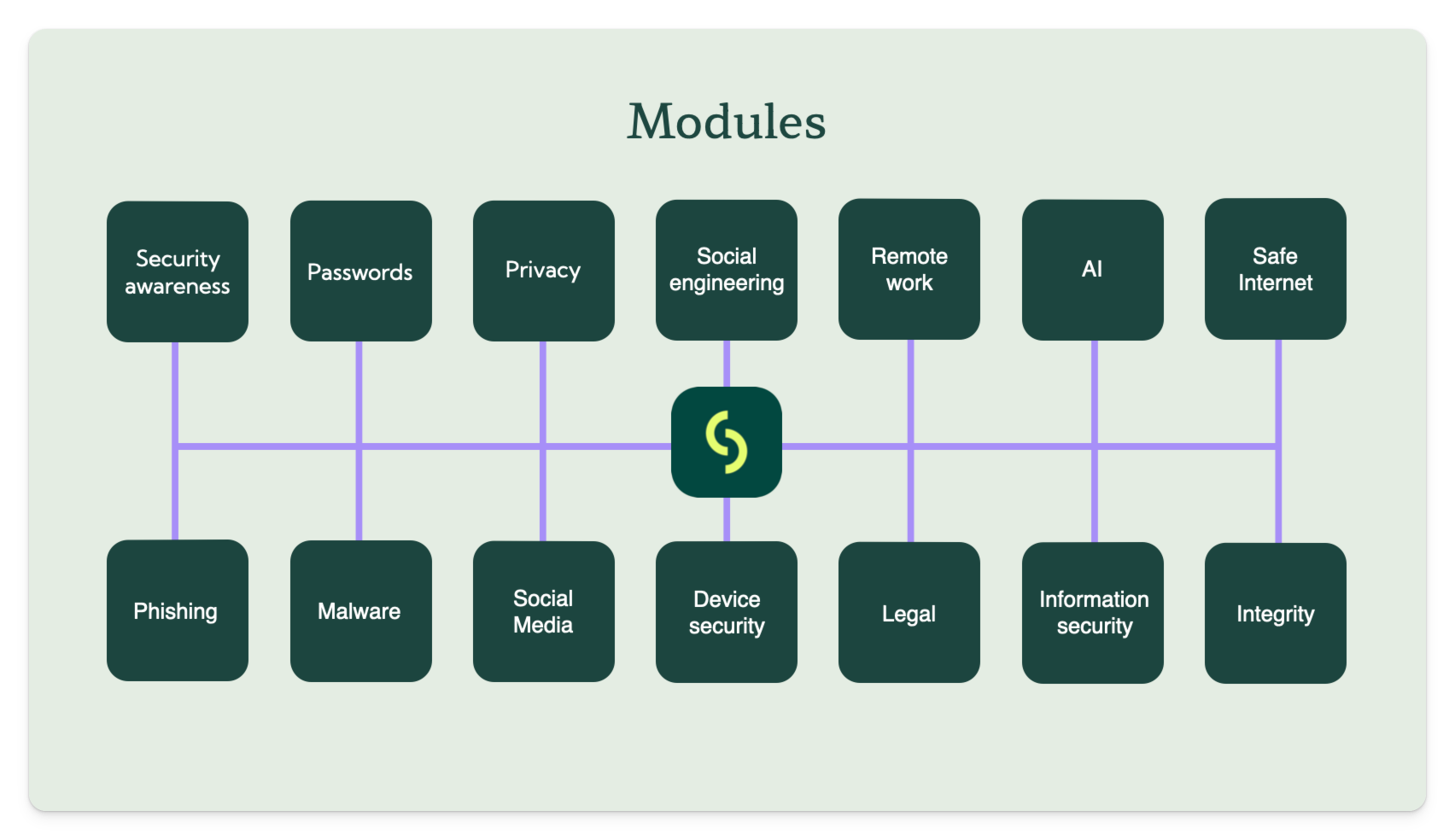
In the training program, Guardey teaches users how to recognize the risks of AI and how to use it safely and ethically. From being able to spot AI-driven phishing attempts or deepfake scams to the do’s and don’ts of using AI tools at work.
What sets Guardey apart from other training programs is its focus on gamification. Users take on weekly 3-minute challenges in which they compete with their colleagues for a top spot on the leaderboard. This creates a form of friendly competition that keeps users engaged and motivated to learn.

By consistently taking on challenges and staying informed about AI and other security threats, your organization builds a strong, sustainable security culture. In such a culture, everyone remains aware of potential risks, and open, ongoing communication becomes the norm. With Guardey, AI literacy is not treated as a one-off initiative, but becomes an integral part of your company’s DNA.
Conclusion
AI literacy should not be just another compliance checkbox. Training your team helps them use AI in a responsible, safe, and effective manner. And with enforcement of the EU AI Act starting in August 2026, there is no reason to wait. With a gamified training program like Guardey, your employees can learn about AI and other security topics in an engaging and fun way. Want to see it for yourself? Try Guardey for free during a 14-day trial.
AI literacy training built for EU AI Act compliance
Turn a legal duty into a real, measurable security habit.
Request a demo